블로그/use-cases·2026년 11월 25일·9분·eroq 팀 작성
Customer service roleplay: 12 angry-customer scenarios to run as live calls
Twelve angry-customer scenarios ready to paste, from a refused refund to a double charge and a cancellation, run as live video calls with one AI customer, plus the rubric to score each call from its transcript.
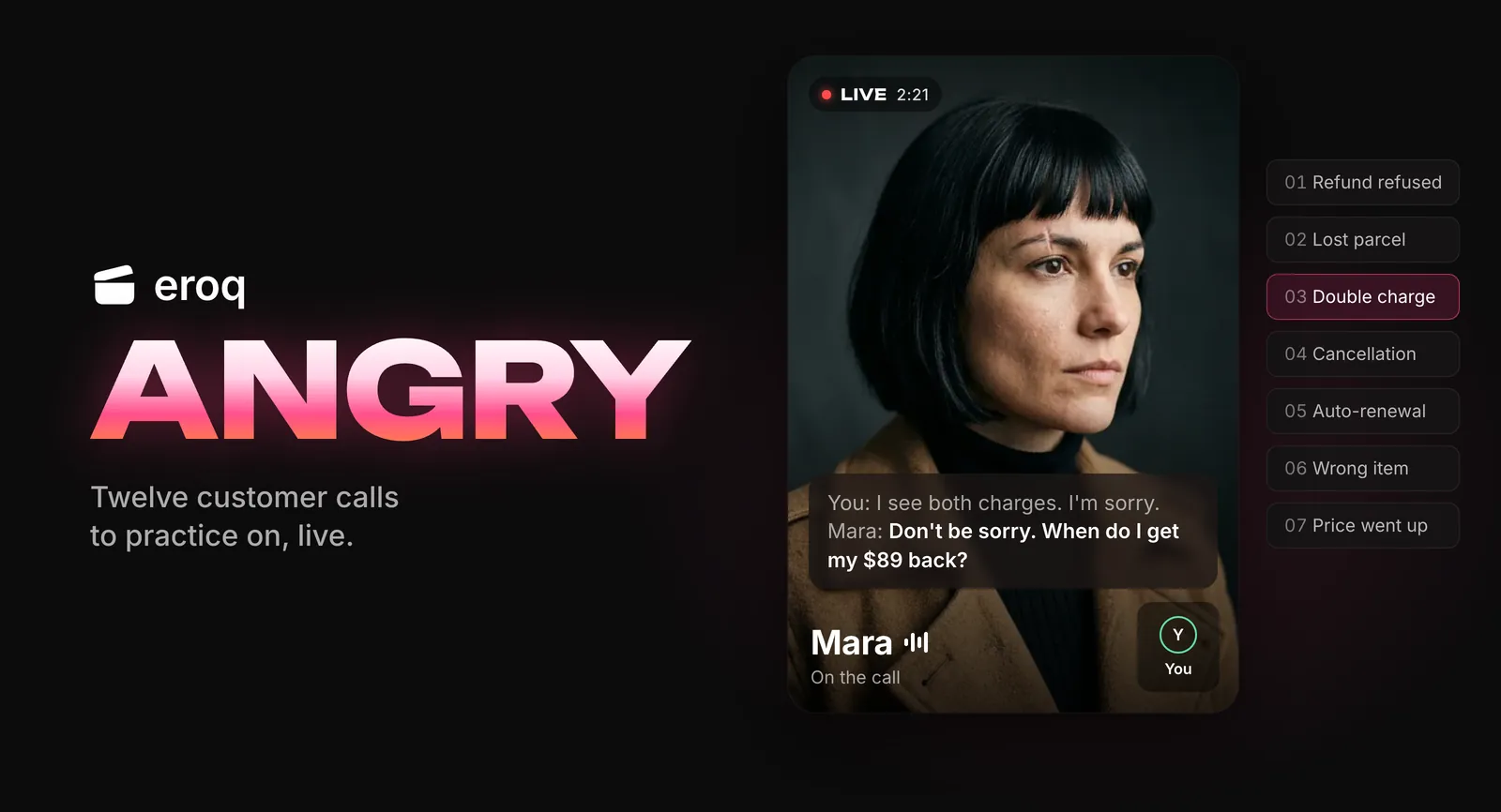
The best customer service roleplay is a call, not a worksheet. The rep hears an angry customer push back, repeat herself and escalate, and has to calm her down and fix the problem in real time. Below are 12 angry-customer scenarios to paste into the scenario field of the eroq Live API, the one customer character who plays all of them, and a rubric to score each call from its transcript.
A support team, a training provider or a contact-center tool can build the drill on the API (the HR guide to AI roleplay training has the whole architecture), and anyone can try a scenario in the studio today.
How the drill works
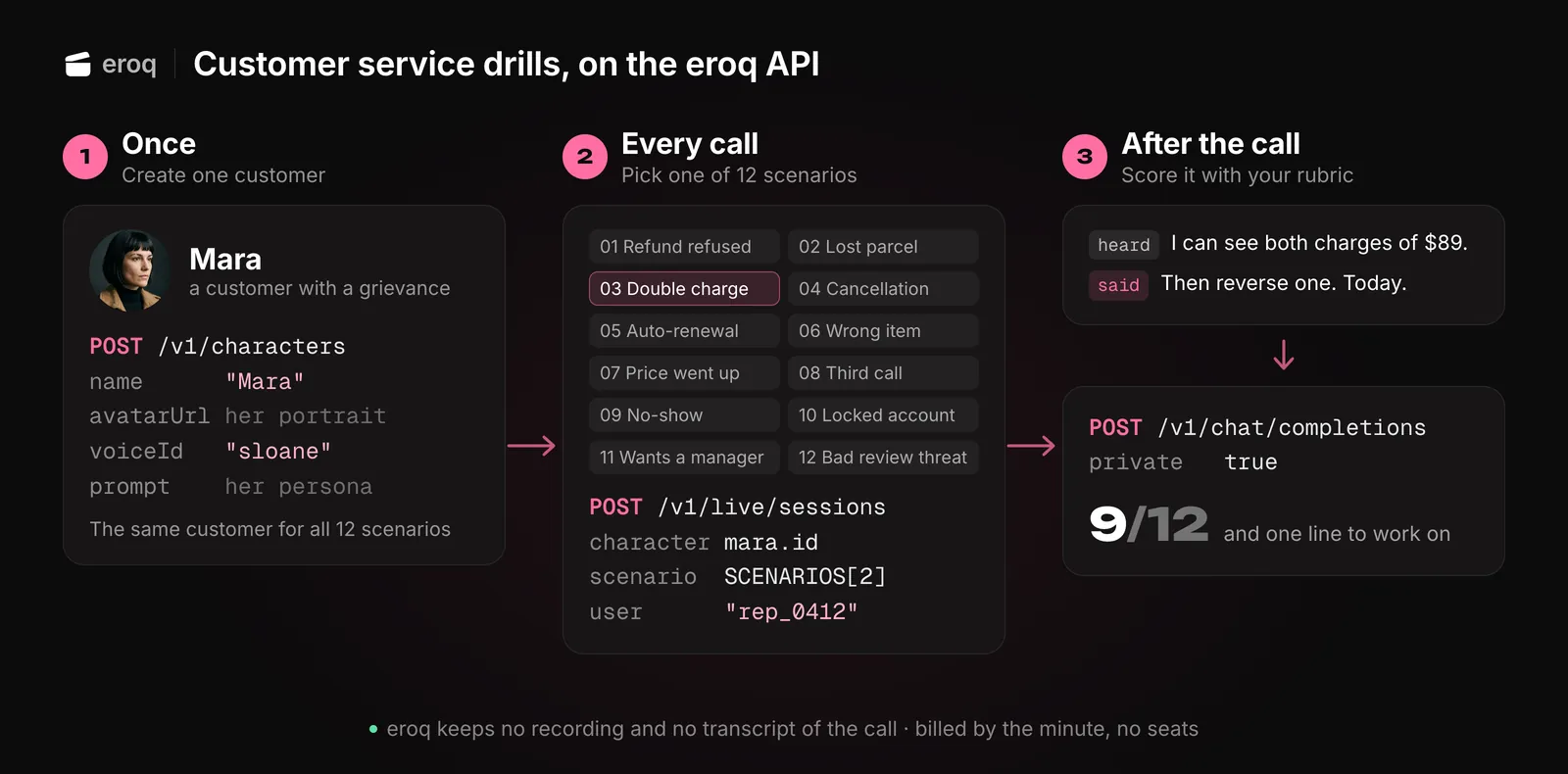
- One customer, created once.
POST /v1/characterswith a portrait, a voice and a persona. Creating a character is free. - Twelve situations. Each call passes one
scenario, this call's grievance, anduser, the rep's id. - The transcript comes with the call. On a data channel named
eroq, your page receives what the rep said (heard) and what the customer says (said). - A score after the call. Your server sends the transcript and your rubric to eroq's chat API.
The customer: one persona for every scenario
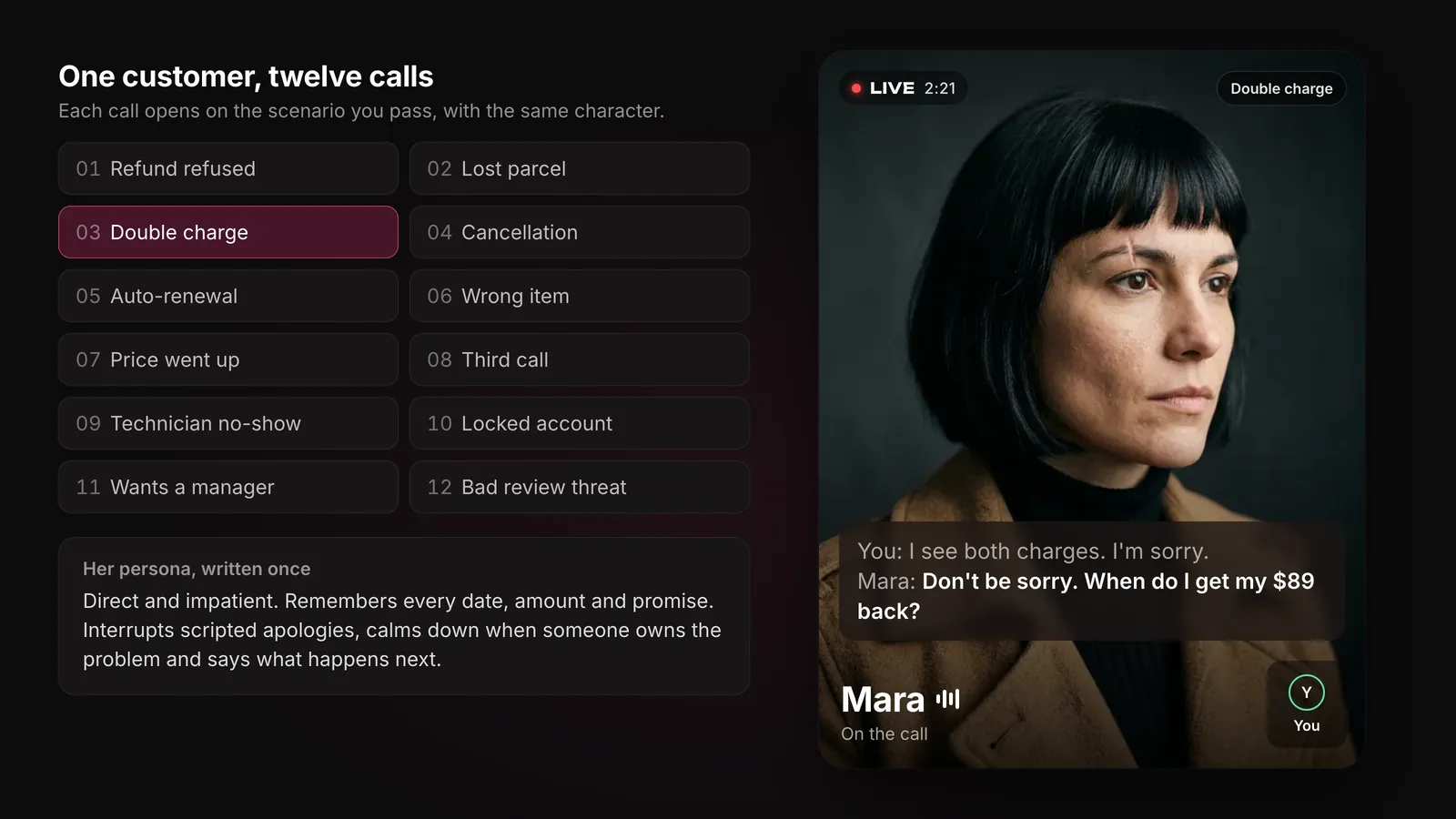
The persona sets her temperament; the scenario sets her complaint. Keep the persona free of any single grievance, so it fits all twelve:
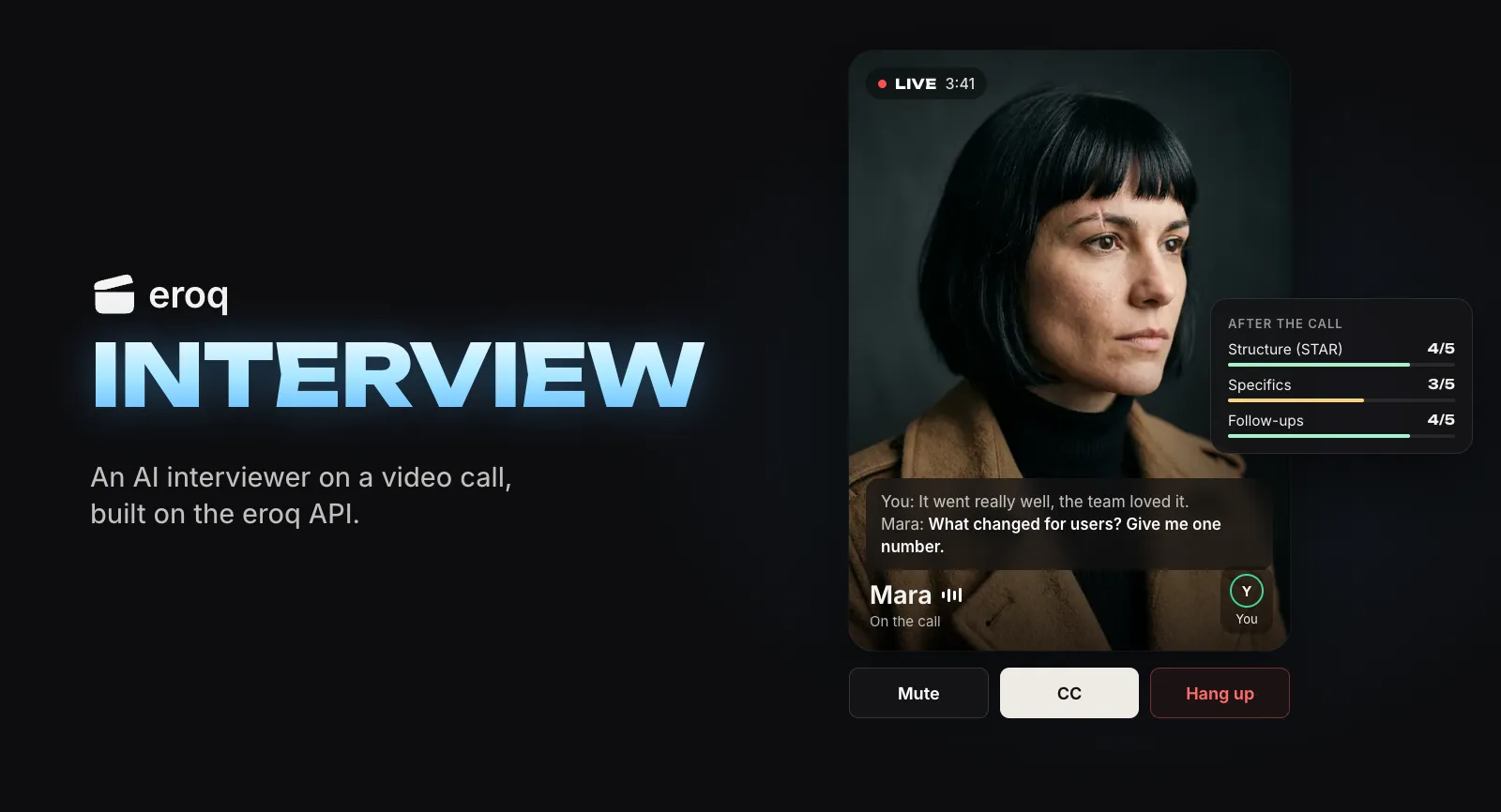
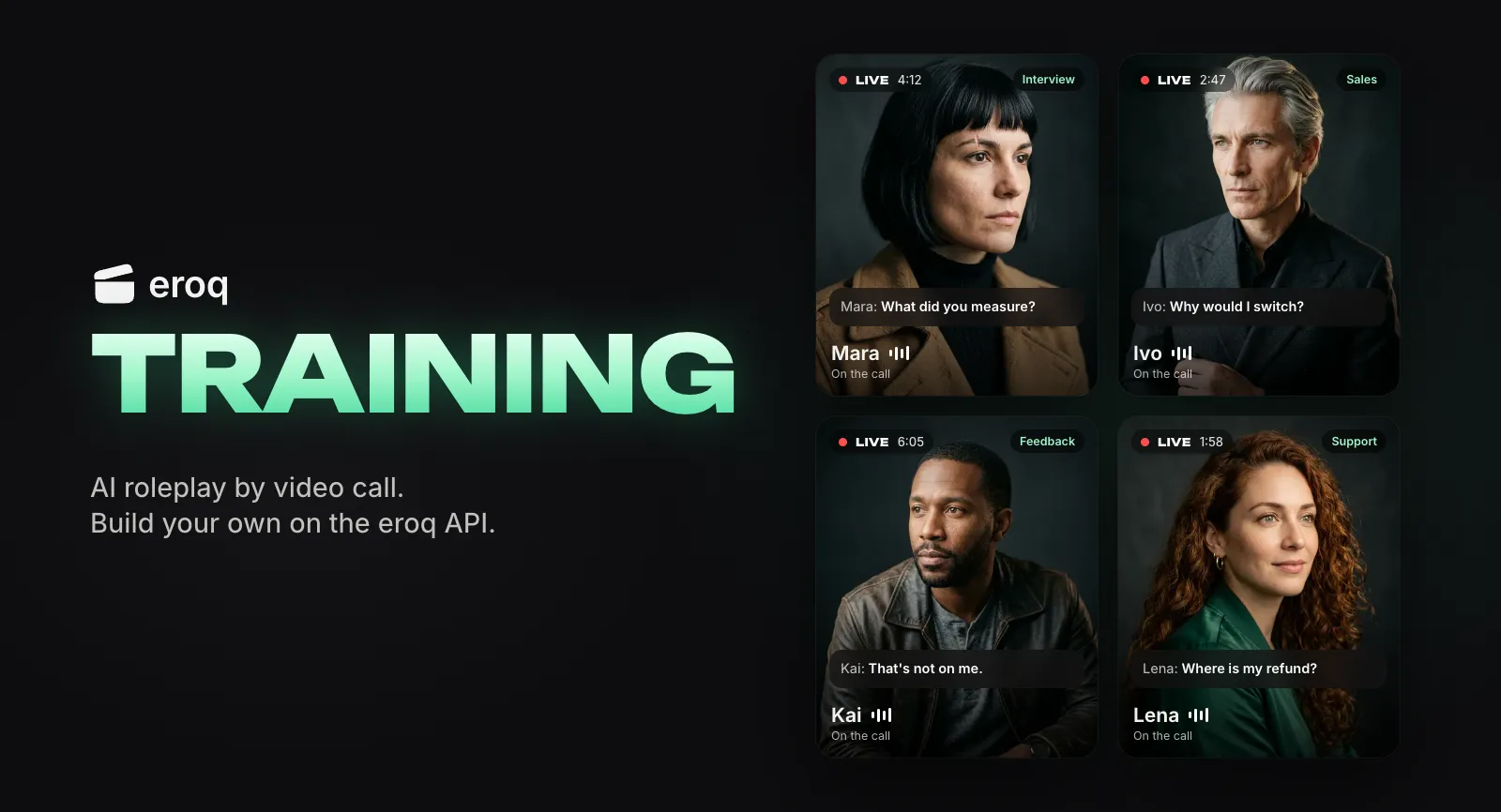
Mara, 41, project manager, a customer for six years. Direct, impatient and precise: she remembers dates, amounts and every promise made to her. She has no patience for scripted apologies ("Stop apologising, when is it fixed?") and repeats her question when it is dodged. She calms down when someone owns the problem and says what happens next, and by when. Never abusive. If the agent is vague or rude twice, she asks for a manager.
The 12 angry-customer scenarios
Each one is written to the customer: "you" is Mara, "they" is the rep. Paste the quoted text into scenario.
- Refund refused. "You returned a coat after 34 days; the policy says 30 and the refund was refused. You found the defect the first time you wore it. You want your money back." The rep wins when they explain the rule once and offer what is possible: a repair, an exchange or store credit.
- Lost parcel. "Tracking says your parcel was delivered yesterday. You were home all day and nothing came. It is a birthday present, needed by Saturday." Wins when they believe her, open a claim and offer a replacement with a date.
- Double charge. "Your card was charged twice for the same $89 order and it pushed your account into overdraft. You want one charge reversed today, not in ten business days." Wins when they confirm both charges, say which one goes, and are honest about the bank's delay.
- Cancellation. "You want to cancel your subscription today. The cancel button online sent you in circles. Offers make you angrier." Wins when they cancel first and confirm nothing more will be charged, with one offer at most.
- Auto-renewal. "Your annual plan renewed overnight for $240. You remember no reminder and have not used the service in months. You want a full refund." Wins when they check what was sent and refund, or offer the closest thing the policy allows.
- Wrong item. "You ordered a black office chair and got a grey one in the wrong size. You start a new job from home on Monday and will not wait for a return first." Wins when they ship the right chair now and send a return label separately.
- Price went up. "Your monthly bill went from $39 to $49. At signup, eight months ago, you were promised a locked price for two years, and you have the email." Wins when they ask for the email and honor it or escalate, never arguing with it.
- Third call. "Third call about the same broken washing machine. Twice you were promised a callback that never came. Open by listing both. You want a name and a date." Wins when they apologize once, then own it: their name, a time, a way back to them.
- Technician no-show. "You took a day off for a technician who never came or called. The next slot is in nine days. You want someone this week, and something for the lost day." Wins when they find an earlier slot and say plainly what compensation exists.
- Locked account. "Your account was locked after a security check, and your accountant needs your invoices today. The verification email never arrives." Wins when they verify her identity another way and give a workaround or a firm time.
- Wants a manager. "You have been on hold for 40 minutes. Open by demanding a manager and refuse to explain again: a $120 refund promised three weeks ago." Wins when they acknowledge the wait, offer to solve it now, and transfer if she still asks.
- Bad review threat. "The hotel cancelled your booking the night before your trip, and the room offered instead is 40 minutes away. Threaten to post the whole story online tonight." Wins when they leave the threat aside and fix it: a comparable room nearby, the difference covered.
Keep the "wins when" line out of the scenario: it is for the scoring.
The code
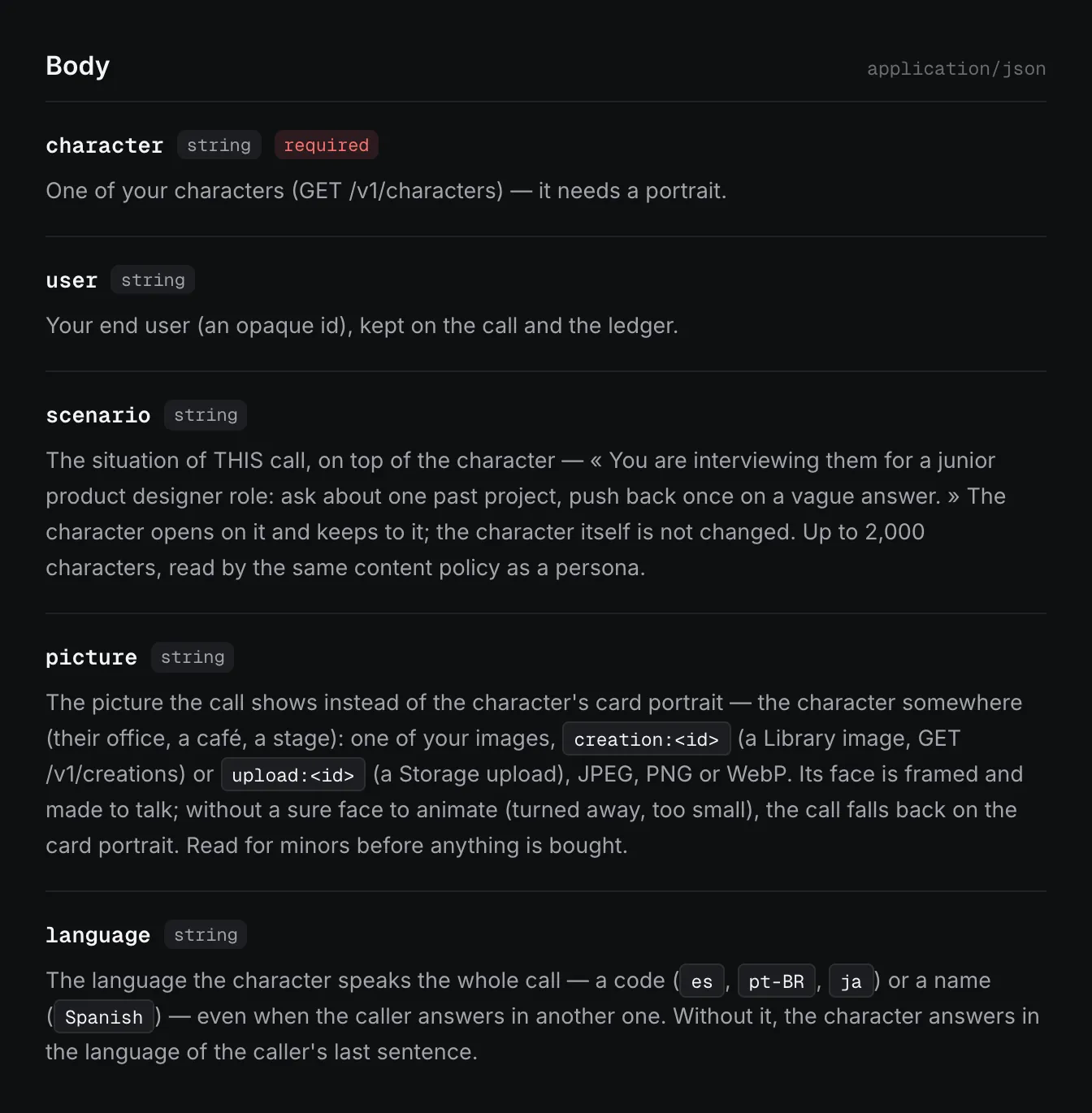
Your server creates Mara once, then opens a call for the scenario the rep picks, with the fields of the Live calls API:
const eroq = (path, body) => fetch(`https://eroq.ai/v1${path}`, {
  method: 'POST',
  headers: { Authorization: `Bearer ${process.env.EROQ_API_KEY}`, 'Content-Type': 'application/json' },
  body: JSON.stringify(body),
}).then(res => res.json())

// Once
const mara = await eroq('/characters', {
  name: 'Mara', gender: 'female', age: 41, voiceId: 'sloane',
  avatarUrl: 'https://your-cdn.example/mara.webp',
  prompt: MARA_PERSONA, // the persona above
})

// Each drill
const call = await eroq('/live/sessions', {
  character: mara.id,
  scenario: SCENARIOS[2], // Double charge
  picture: 'creation:<id>', // optional: Mara at her kitchen table
  user: 'rep_0412',
})
With picture, a Library image or a Storage upload of Mara somewhere, the call frames her face in that scene. The rep's browser opens the WebRTC connection with call.ice_servers and, before its offer, a data channel named eroq. Each message on it is JSON, { "type": "eroq-live", "event": "heard" | "said", "text": … }: push them into a transcript as they arrive. Your server relays the offer and the answer, and buys each next minute with POST /v1/live/sessions/{id}/extend.
Score each call from the transcript
eroq does not score calls: your product applies the rubric. Six criteria, two points each, one when partly there:
| Criterion | 2 points | 0 points |
|---|---|---|
| Acknowledge | Names the problem in her words within the first two replies | Makes her repeat what she already said |
| Empathy, no script | One sincere apology, then action | "I understand your frustration" on a loop |
| Ownership | Says what they will do, and by when | "Another team handles that" |
| Accuracy | Promises only what the policy allows | Promises, then takes it back |
| De-escalation | Her last lines are calmer than her first | She ends angrier than she started |
| Close | Recaps the fix, the date and how she will hear back | Ends on "anything else?" |
One request to eroq's chat API applies it:
const score = await eroq('/chat/completions', {
  model: 'claude-fable-5-2',
  private: true,
  messages: [
    { role: 'system', content: `Score this customer service practice call with the rubric below. For each criterion give 0, 1 or 2 and quote the line that justifies it, then write one coaching note. Answer in JSON.\n\n${RUBRIC}` },
    { role: 'user', content: transcript.join('\n') },
  ],
})
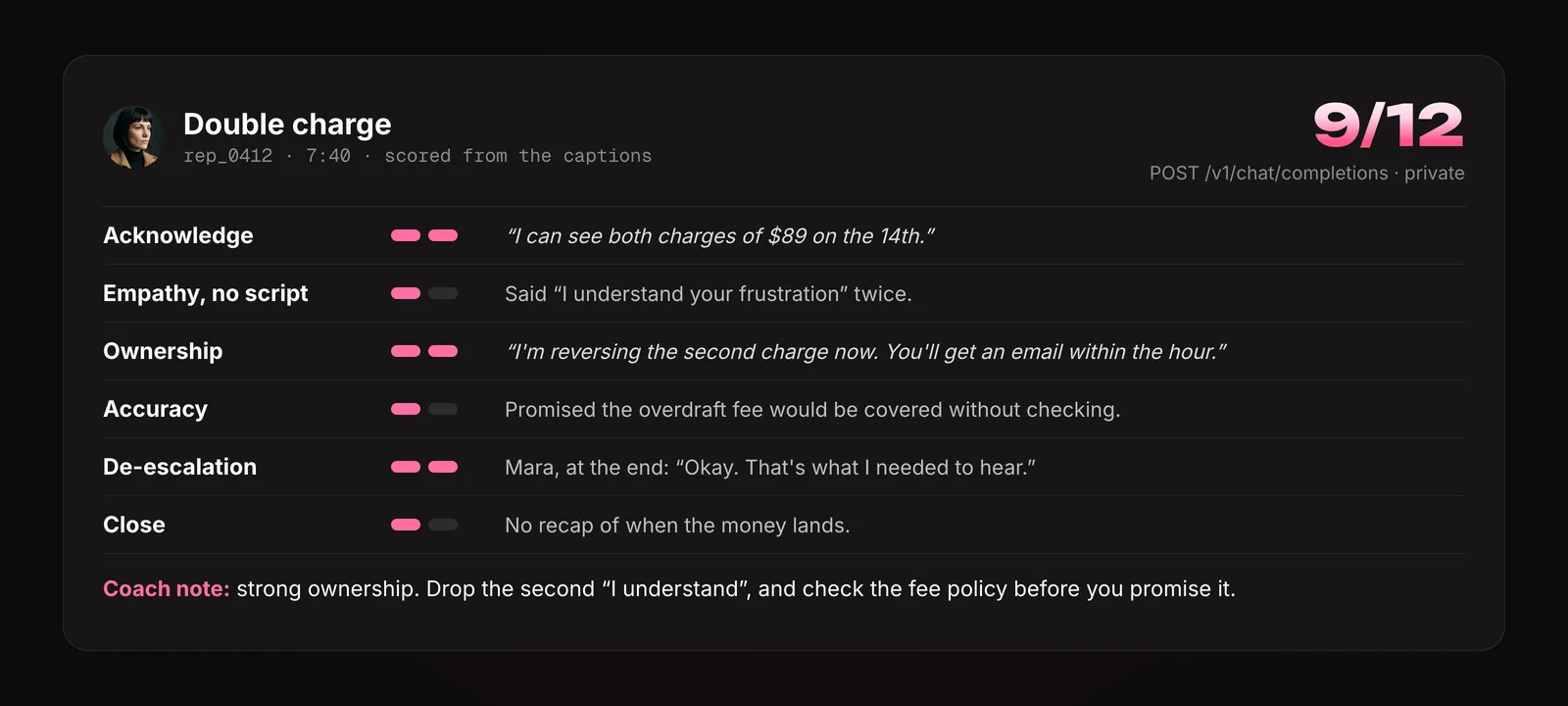
Keep each rep's scores to show progress and pick the next scenario.
Private, by the minute, no seats
eroq keeps no audio, no video and no transcript of a call: the captions reach only your page. With private: true, the scoring request is not written anywhere on eroq's side either. The call's record holds its length, its credits and the user id you passed.
A call costs 100 credits a minute, bought ahead, and a call that never connects gives its minute back. All twelve scenarios at about six minutes each, scored, come to 7,440 credits, about $62 at the rate of the $100 Scale pack. No seat to pay for a rep who is not training this week.
What it does not do
- No built-in score or scenario library. The rubric runs in your product; these twelve are yours to paste and extend.
- No knowledge base. A scenario holds 2,000 characters: the facts of one case, not your whole policy.
- Two open calls per workspace, two hours at most per call: a class of twenty cannot all call at once.
- A reply takes a few seconds, and a cold start can take a minute or more to pick up.
- Microphone only. The customer hears the rep but does not see them.
Try one in the studio
In eroq Live, create a customer with a face, a voice and Mara's persona, pick her, paste a scenario into Situation in the row under her, and call. The help page covers a first call.
FAQ
What are good customer service roleplay scenarios?
The ones reps meet every week: a refused refund, a lost parcel, a double charge, a cancellation, a surprise renewal, a wrong item, a price rise, a third call about the same problem, a missed appointment, a locked account, a demand for a manager and a review threat. Each works best with a real detail (an amount, a date, a promise).
How do you roleplay an angry customer with AI?
Give an AI character an impatient, precise persona, then open each call with the grievance as a scenario. On eroq Live she answers out loud with a face and a voice, pushes back on every dodge, and calms down when the rep owns the problem.
Can the AI score the call?
Your product can, in one request: send the transcript and your rubric to eroq's chat API, and it returns a score per criterion with quoted lines and a coaching note.
Is the call recorded?
No. eroq keeps no audio, video or transcript of a call; the captions go to your page only.
How much does a roleplay call cost?
100 credits a minute, and 20 credits to score it with Claude Fable 5.2. No seats and no subscription to the tool.
More: AI roleplay training, the HR guide · eroq Live, video call your characters · AI video call · Live calls API.

프라이버시
프라이빗하고, 제한 없이
- eroq 자체 엔진엔 필터가 없어요. 대신 명문화된 정책 하나가 있어요.
- 아무것도 보관하지 않고, 작업물을 학습에 쓰지도 않아요.
- 프라이빗 모드는 파일을 전혀 남기지 않아요.