blog/guides·25 nov 2026·8 min·por el equipo de eroq
Best real-time AI avatar APIs in 2026: Tavus, HeyGen, Anam, Simli and eroq Live
The real-time AI avatar APIs worth building on in 2026, compared on transport, what you bring, billing, what is kept after the call and where each one is strongest. Tavus, HeyGen LiveAvatar, Anam, Simli and eroq Live.
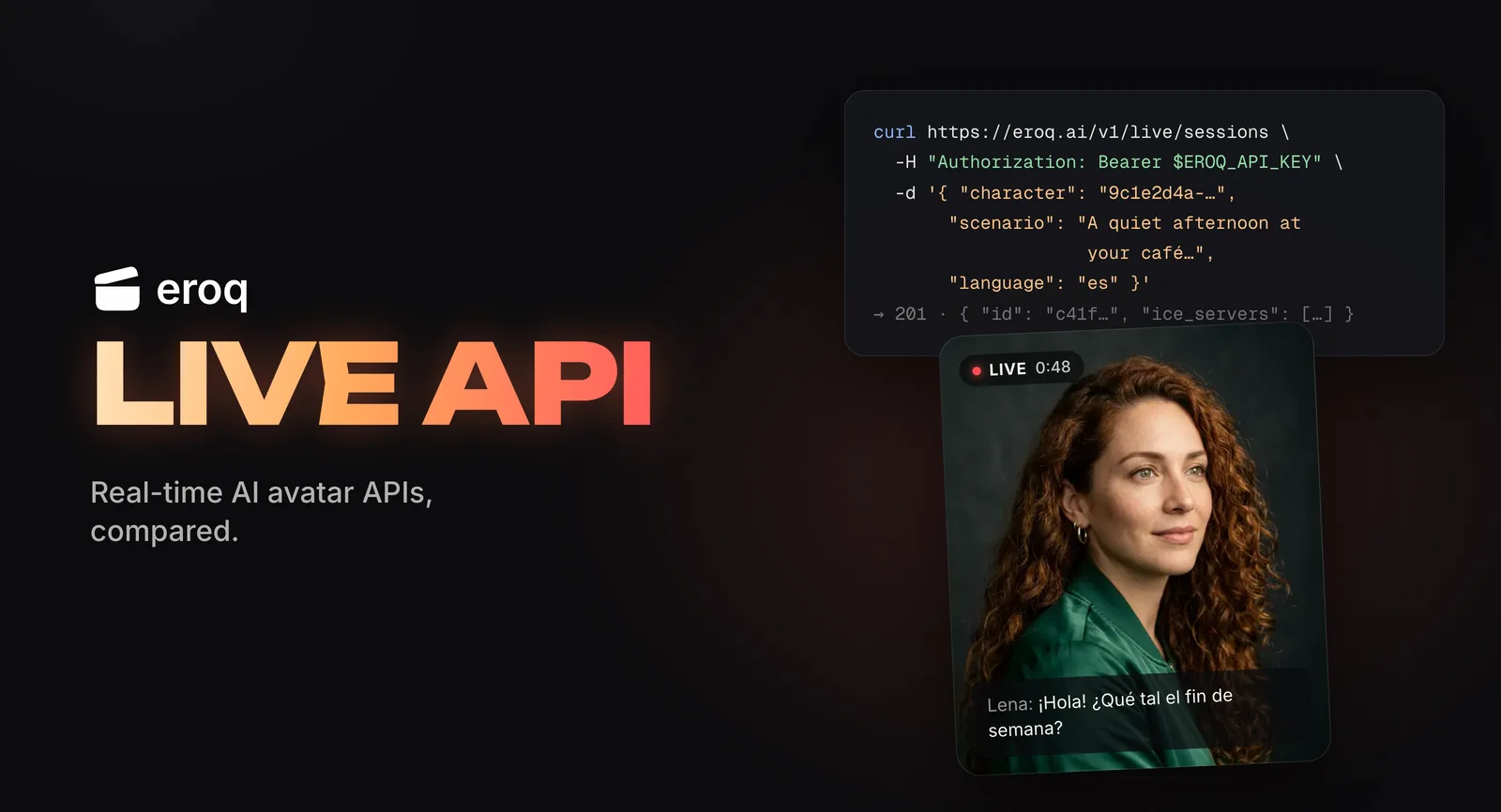
The best real-time AI avatar API depends on what you are building. Tavus if you want a complete agent that also sees the user and sends a transcript after the call. Anam if reply speed comes first. HeyGen LiveAvatar if your avatars already come from HeyGen. Simli if you already run a voice agent and only need a face. eroq Live if you want your own character, with their portrait, their voice and an uncensored persona, billed by the minute from prepaid credits with no subscription, and nothing kept after the call.
All five stream over WebRTC: the user talks, and the avatar answers live with a voice and a lip-synced face, not a clip rendered from a script. They differ on what you bring, how you pay and what stays on their side once the call ends. Facts about other services were checked on their own pages and docs in November 2026; this market moves fast, so check their terms before you build.
The short answer
| Transport | What you bring | Billing | After the call | Best for | |
|---|---|---|---|---|---|
| eroq Live | WebRTC, face 512×512 at 25 fps | A portrait, a voice (library or cloned), a persona; a scenario, a language and a picture per call | 100 credits a minute, prepaid, no subscription | Live captions on a data channel; eroq keeps nothing | Your own characters, uncensored personas |
| Tavus | WebRTC, through Daily | A PAL (behaviour, knowledge, objectives, guardrails) and a Face | Monthly plans with included minutes, free tier | Transcript and perception analysis by callback; recordings to your storage | Agents that also see the user |
| HeyGen LiveAvatar | WebRTC | An avatar from a video or a photo; your own language model in Lite mode | Monthly credit plans: a credit is 30 s in Full mode, a minute in Lite | Full mode keeps transcripts (deletable by API); Lite keeps no session data | Teams already on HeyGen |
| Anam | WebRTC | A persona: stock or custom avatar, voice, language model, prompt | Monthly plans with included minutes, billed per second, free tier | Transcripts and recordings by API, except zero-retention sessions | Fast replies, 70+ languages |
| Simli | WebRTC, peer to peer or LiveKit | Your voice agent, or Simli Auto; a face from a photo | Monthly plans with included minutes, free tier | Up to your pipeline | A face on an agent you already run |
1. eroq Live
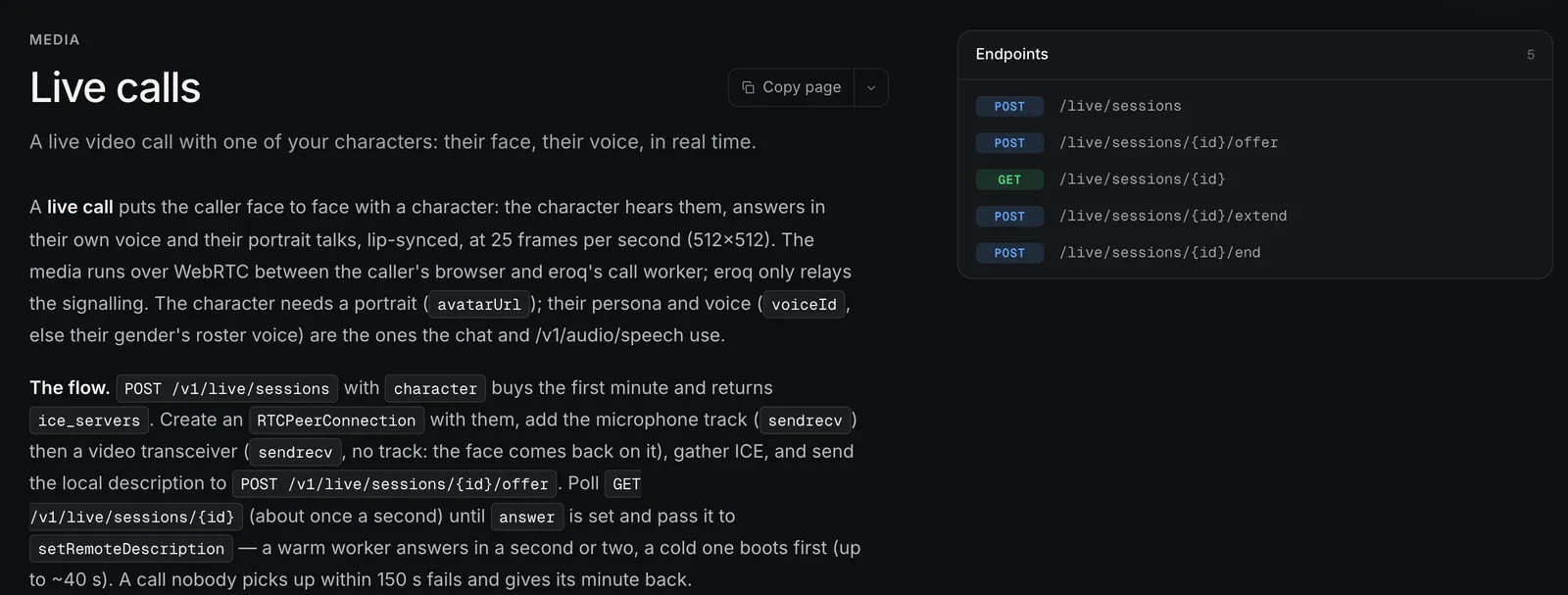
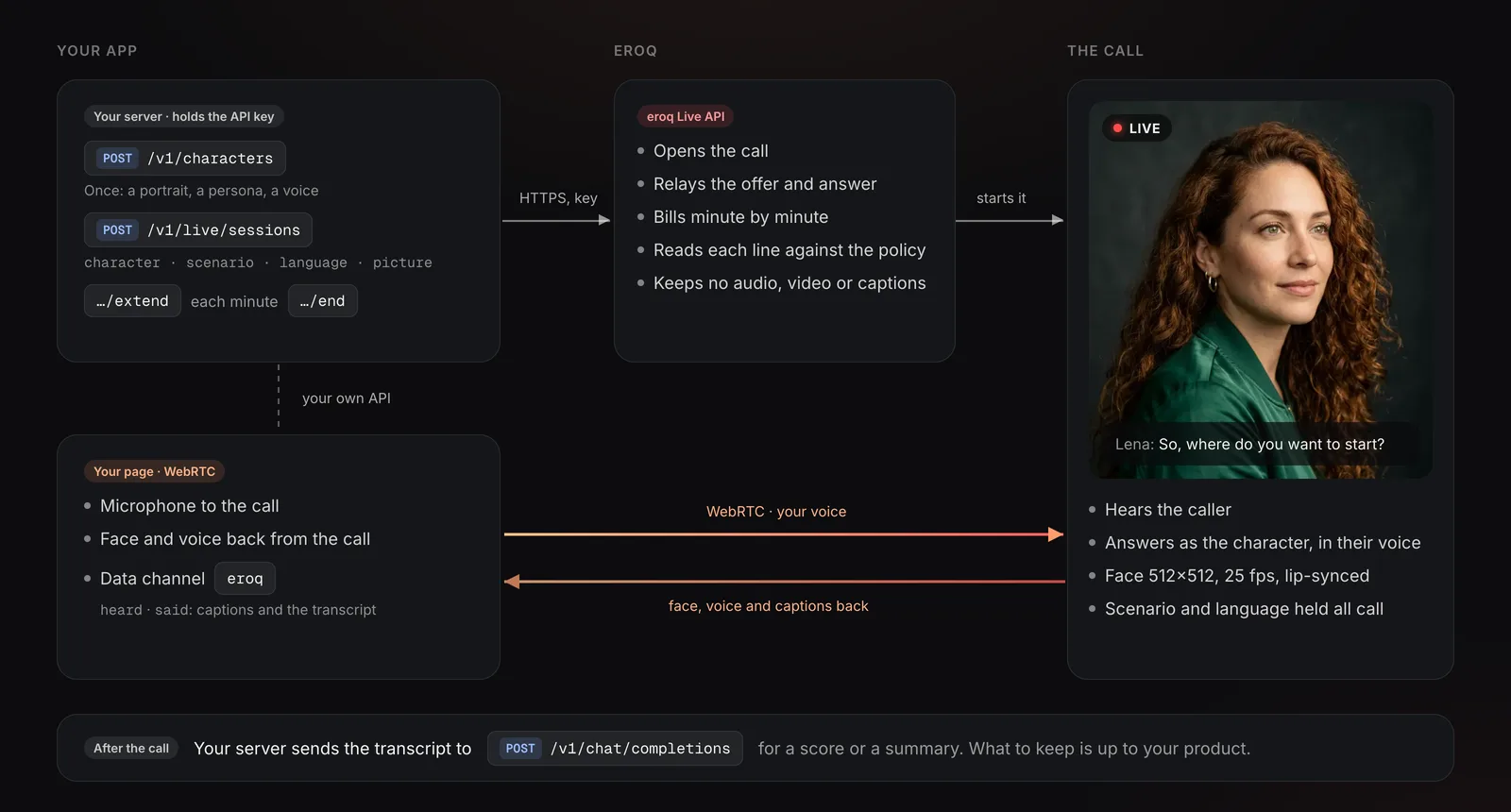
eroq Live calls one of your own characters. You create the character once with POST /v1/characters: a portrait, a persona of up to 4,000 characters, and a voice from the library or a free clone made with POST /v1/voices. POST /v1/live/sessions opens the call, your page connects over WebRTC, and the character answers in that voice while their portrait talks, lip-synced, at 25 frames a second.
One character, many calls. Each call can take a scenario, the situation of this call (an interview for a given role, a customer with a given complaint), and a language the character holds for the whole call, even when the caller switches. A picture from your Library puts them somewhere, at a desk or in a café, instead of their card portrait. One character can run every interview drill, sales or support practice, or language session.
Captions on a data channel. The call sends what the caller said (heard) and each sentence the character speaks (said) on a data channel named eroq: captions during the call, a transcript to score afterwards, for example with eroq's own chat API.
Billing and privacy. A call costs 100 credits a minute, bought a minute at a time; a call that never connects gives its minute back. No subscription: the $10 Starter pack (1,000 credits) is 10 minutes of calls. eroq keeps no audio, no video and no captions: the call's record holds its length and the credits it used.
Uncensored, with a written policy. The persona is yours, dark fiction included, under the acceptable-use policy: fiction only; nothing involving minors, no real identifiable people without consent, nothing illegal. Every character is 18 or older, and a line that crosses the policy gets a change of subject.
What it does not do yet. A reply comes a few seconds after the caller stops talking, slower than the fastest services here, and a cold start can take a minute or more before the character picks up. There is no score or report after the call: you build it from the captions. The character does not see the caller, there is no knowledge base, and you call your own characters, not a stock catalogue. A workspace holds two open calls at a time, two hours each at most.
Best for: apps whose users call characters they made, uncensored roleplay, and drills paid by the minute.
2. Tavus
Tavus calls its product the Conversational Video Interface. You build a PAL (the docs used to say persona): its behaviour, knowledge, objectives and guardrails, a Face for the look and a voice. Conversations run over WebRTC through Daily. Its perception layer, Raven, can read the user's expressions, gaze and shared screen; an eroq character only hears the caller. After a call, Tavus can send the transcript and a perception summary to your webhook, and recordings can go to your own cloud storage. Its pricing page lists monthly plans with included minutes, a free tier, and a 30-second minimum per conversation.
Best for: agents that should react to what the user shows on camera, with post-call data built in.
3. HeyGen LiveAvatar
LiveAvatar is the production version of HeyGen's Interactive Avatar, streamed over WebRTC. In Full mode HeyGen runs the whole conversation, keeps session transcripts and lets you delete them by API. In Lite mode you plug in your own language model and HeyGen keeps no session data. A custom avatar is made from a video or a photo. LiveAvatar is sold in monthly credit plans, separate from HeyGen's API credits: a credit buys 30 seconds in Full mode and a minute in Lite.
Best for: teams that already make their avatars in HeyGen.
4. Anam
Anam builds a persona from an avatar (from its library or made from one image), a voice, a language model and a prompt, and lets you define personas at runtime. Audio and video go over WebRTC, and the browser connects with a short-lived session token, so your API key stays on your server. It claims 70+ languages, and its own October 2026 benchmark gives a 1.24 s median reply. Transcripts and recordings can be fetched by API, except for zero-data-retention sessions, an Enterprise option. Plans include a number of minutes and are billed per second, with a free tier.
Best for: products where every half-second of reply time counts.
5. Simli
Simli is the face layer for real-time agents. You plug it into a voice pipeline you already run (LiveKit Agents, Pipecat, a speech-to-speech model) or use Simli Auto, which takes a system prompt, a language model and a voice. Video goes over WebRTC, peer to peer or through LiveKit, and a face can be made from a photo. Its plans include minutes each month, with a free tier; since it supplies only the face, your speech, language model and voice are billed on their side.
Best for: adding a face to a voice agent you already built.
Try eroq Live
Call a character in the studio first, at eroq Live. Then open the same call from code:
curl https://eroq.ai/v1/live/sessions \
  -H "Authorization: Bearer $EROQ_API_KEY" \
  -H "Content-Type: application/json" \
  -d '{ "character": "9c1e2d4a-6b7f-4c3d-9e8a-1f2b3c4d5e6f", "scenario": "You are interviewing them for a junior product designer role.", "language": "es" }'
The full flow, with WebRTC, captions and minute-by-minute billing, is in Add a video-call character to your app. To write a persona that holds a spoken conversation, read How to write a character persona that holds a live call. The reference is Live calls, and the launch post is eroq Live.
FAQ
What is a real-time AI avatar API?
An API that streams a talking face into your app during a conversation. The user speaks, the service transcribes, a language model answers, a voice speaks the reply and a face moves with it, all over a live connection, usually WebRTC.
Which real-time avatar API is cheapest?
It depends on your volume, and these price lists change often, so compare them on the day. Tavus, HeyGen, Anam and Simli sell monthly plans with included minutes, and Simli supplies only the face, so your own voice pipeline adds its cost. eroq Live has no plan: 100 credits a minute from prepaid credits, and a call that never connects gives its minute back.
Can I use my own character's face and voice?
On eroq Live, yes: the portrait and the voice on your character, a library voice or one you cloned. Tavus, HeyGen and Anam make custom avatars too, and Simli makes a face from a photo.
Which avatar API allows uncensored personas?
eroq Live runs the persona you write with no filter on top, under a written policy: fiction only, nothing involving minors, no real people without consent, nothing illegal, every character 18 or older. Check each provider's own terms for theirs.
How fast does an eroq Live character answer?
A few seconds after the caller stops talking. The first call on a cold machine can take a minute or more to pick up.
More: Real-time AI avatar · AI video call · Talking head.

Ruédalo en Video
Todo lo de arriba ocurre en el estudio: los mismos motores, los mismos ajustes, renderizado con tu clic.
40 créditos gratis · sin tarjeta · modo privado en todas las cuentas
Prueba este prompt
Tracking shot alongside a skateboarder bombing down a steep San Francisco street at golden hour, low angle, motion blur
Privacidad
Privado y sin restricciones
- Sin filtros en los motores propios de eroq: una política escrita en su lugar.
- No conservan nada y nada se entrena con tu trabajo.
- El modo privado no guarda ningún archivo.