
博客/guides·2026年10月10日·5 分钟·作者:eroq 团队
The cheapest AI video engine per second in 2026 — and the fastest
Price per second and usual render time for every AI video engine on one roster — Seedance, Veo, Kling, Hailuo, Runway, Grok Imagine, Wan, Motion One — read from the billing catalogue, with the trade-offs each cheap second hides.
The cheapest second of AI video in October 2026 costs 10 credits on Motion One, eroq's own engine, at 480p. Then come 15 credits on Seedance 2.0 Mini at 480p and 22 credits on Veo 3.1 Lite at 720p with sound (less picture-only). The dearest costs 16 times as much, and is worth it for exactly one kind of shot. This article reads the AI video cost index — the dated table every figure below comes from — and says what each cheap second gives up.
The per-second ladder
Prices are the credits eroq bills per second at the engine's default resolution, sound on where the engine offers it; one credit is about a cent on the Starter pack and less on a plan. Veo and Kling bill sound as an option, so their picture-only second is lower: the index has both rates.
| Engine | Per second | 5-second clip | Why it is there |
|---|---|---|---|
| Motion One | 10 at 480p, 29 at 768p | 50, 145 | eroq's own engine, uncensored within policy, private, every account |
| Seedance 2.0 Mini | 15 | 75 | The entry engine on every account, 480p |
| Veo 3.1 Lite | 22 | 110 | Google's entry tier, 720p, 8 seconds, sound included at this rate |
| Hailuo 3 Max, Seedance 2.0 Fast, Wan 3.0 | 34, 39, 43 | 170, 195, 215 | Hobby's quick ones; Wan goes to 30 seconds |
| Veo 3.1 Fast, Kling 3.0 | 43, 54 | 215, 270 | Faces and motion on a Hobby plan, sound included at these rates |
| Runway Gen-4.5, Kling 3.0 Pro, Seedance 2.5 | 51, 71, 98 | 255, 355, 490 | The Creator tier: prompt fidelity, faces, long clips |
| Veo 3.1 | 169 | 845 | The 1080p keeper, native sound, the dearest seconds |
The index has every resolution and the rate with sound where it differs; this table takes the lowest.
What a cheap second gives up
Resolution. The cheapest engines render 480p or 720p. For a vertical clip on a phone screen, 720p is the delivery format anyway; for a 16:9 piece on a monitor, the 1080p engines cost two to six times more per second and look it.
Length. Veo 3.1 Lite stops at 8 seconds, Seedance 2.0 Mini at 15. A thirty-second single take exists on Seedance 2.5 and Wan 3.0 only, and costs 2,940 credits on the former. Longer than that is a storyboard in Cinema, scene by scene.
Faces. The entry engines invent a plausible person; they do not hold your person. Casting a character by name, with their identity sheet, is what Kling 3.0 Pro, Seedance 2.5 and Hailuo 3 are priced for, and what eroq Replace Pro does on an existing clip.
Sound. Most engines render the soundtrack with the picture; Veo and Kling bill it as an option, which is why the index shows two rates for them.
Moderation. The other cheap seconds are third-party engines, moderated upstream. The engine with no provider in the middle is Motion One, at 10 credits per second at 480p and 29 credits at 768p.
The fastest second
Price is one axis; the other is how long you wait. Usual render times on eroq run from under a minute on Seedance 2.0 Mini and Veo 3.1 Lite to about two and a half minutes on Motion One, Seedance 2.5, Kling 3.0 Pro and Hailuo 3, then about five on eroq Replace Pro, which has the hardest job (a whole clip, every cut, your faces). The index lists the usual minutes per engine; the studio announces them under the progress bar, and a render past its usual time is not a failed one, just a busy queue. A render that does fail refunds itself.
Cheapest per finished clip
A cheap second that needs three takes costs more than a dearer one that lands first time. The honest budgeting unit is the finished clip, takes included; how much does AI video cost does that arithmetic with three real budgets. The rule of thumb from it: draft on the entry engine until the prompt is right, then render the keeper on the engine the shot deserves. The studio's Remix keeps the prompt and the settings across engines, so the switch is one click.
Where the numbers come from
The index is generated from the same catalogue the API bills from: a price change reaches the page, its JSON and its markdown at once, and the change log on the page says what moved and when. Nothing in this article was typed from memory; every figure is a token resolved against that catalogue when the page is served.
FAQ
What is the cheapest AI video generator right now?
On eroq, Motion One, eroq's own engine, at 10 credits per second at 480p; among the third-party engines, Seedance 2.0 Mini at 15 credits per second and Veo 3.1 Lite at 22 credits with sound. All three are on every account. A five-second clip costs 50, 75 or 110 credits, $0.50 to $1.10 at the entry pack rate.
Is a free AI video generator realistic?
A new account's 40 free credits cover one five-second Motion One clip at 480p (50 credits). Beyond that, a $10 pack is 1,000 credits: 20 of those clips, 13 on Seedance 2.0 Mini, or 1 on Veo 3.1.
Why is Veo 3.1 so much more per second?
It renders 1080p or 4K with native sound and dialogue, and holds complex scenes; the price is the provider's, passed through with eroq's margin. For a vertical social clip it is rarely the right engine; for a 16:9 keeper it often is.
Does the price change with the plan?
The credits per second are the same on every plan; what changes is what a credit costs you (less on larger packs and plans) and which engines the plan unlocks. The pricing page has the ladder.
Are these prices the same through the API?
Yes. The studio is a client of the public API and bills the same function; GET /v1/models returns the same rates the index shows.
试试这个提示词
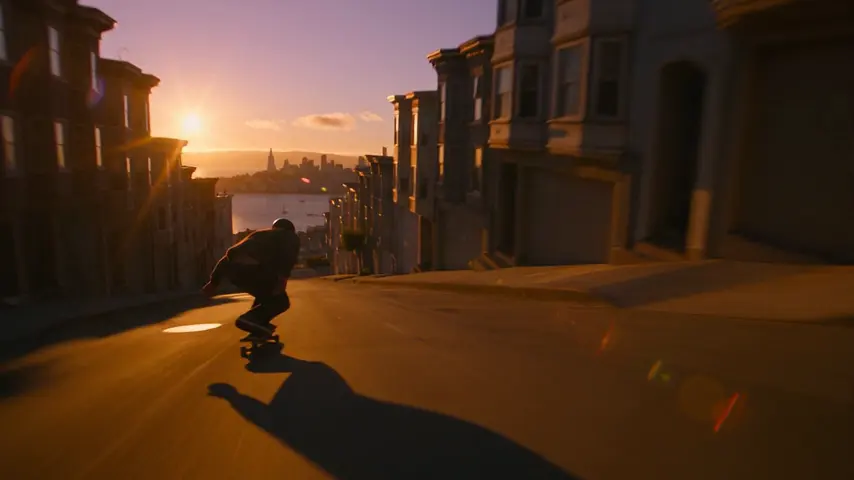
Tracking shot alongside a skateboarder bombing down a steep San Francisco street at golden hour, low angle, motion blur