博客/use-cases·2026年11月25日·8 分钟·作者:eroq 团队
AI mock interview on a video call: build an AI interviewer
Build an AI mock interview tool on the eroq API. A recruiter persona to copy, STAR questions and follow-ups, a scenario per role, and a review written from the transcript after the call.
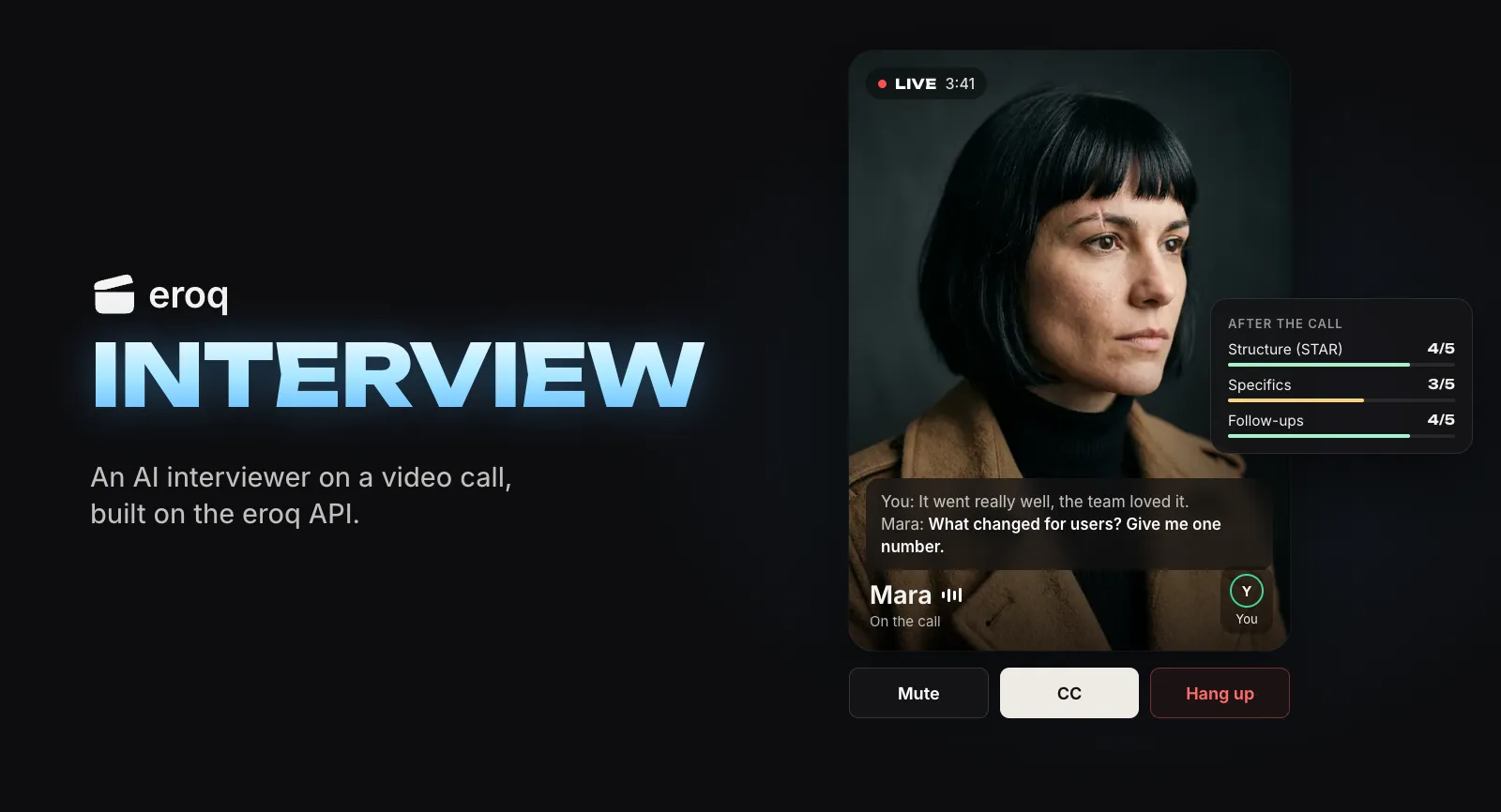
An AI mock interview is a practice interview with an AI interviewer who asks real questions, listens to the answers and follows up when they are vague. On eroq the interviewer is a character on a video call, with a face and a voice. The eroq API lets you build your own mock interview product. You create the recruiter once, then give each call the job it is for (scenario) and the language to hold. The captions channel gives you the transcript, and a chat request writes the review. It is billed per minute, with no seats, and eroq records nothing.
This guide gives you a recruiter persona to copy, a scenario per role, the review prompt, and the reverse drill: a recruiter practising with an AI candidate.
What a good AI interviewer does
A useful interviewer behaves like a good human one:
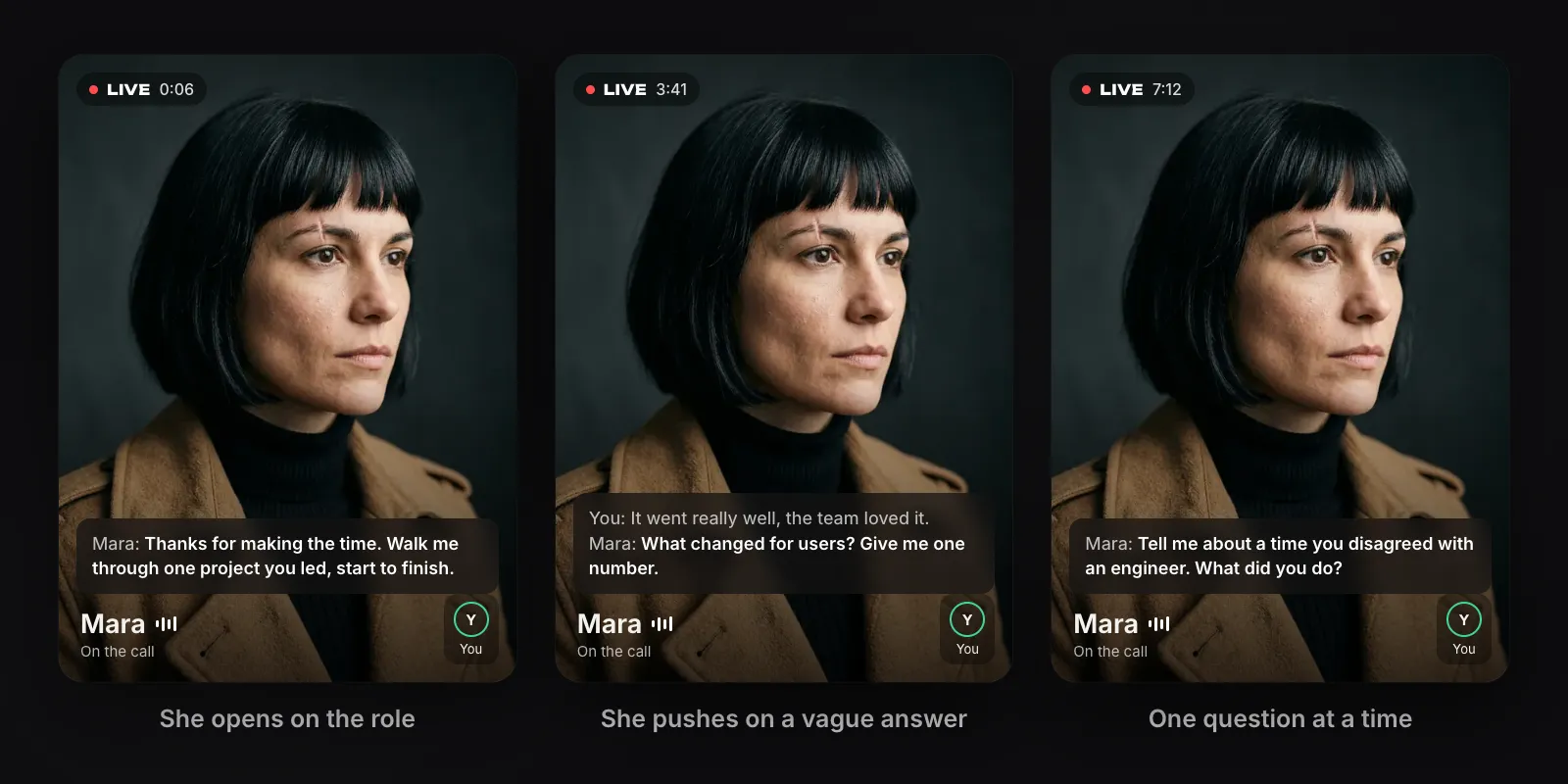
- One question at a time, and she waits for the whole answer.
- Behavioural questions. "Tell me about a time when…" invites a STAR answer: the situation, the task, what the candidate did, and the result.
- She pushes on vague answers. "The team loved it" gets "What changed for users? Give me one number."
- She does not coach during the interview. The feedback comes after the call, from your app.
- Short turns. On a call, a long monologue from the interviewer wastes the candidate's minutes.
The recruiter persona to copy
The persona describes who the interviewer is and how she behaves. The job goes in the scenario of each call, so one recruiter can interview for every role. Paste this into the character's persona, in the studio or as prompt in POST /v1/characters (up to 4,000 characters):
Mara is a senior recruiter at a software company: calm, precise, polite and hard to impress.
She runs structured interviews on video calls.
- She asks one question at a time and waits for the whole answer.
- Her questions are behavioural: "Tell me about a time when..." She expects the situation, what the candidate did and the result.
- When an answer stays vague, she asks once for a number, a name or an example. When the candidate says "we", she asks what they did themselves.
- She keeps her own turns to one or two sentences, then asks the next question.
- She never gives the answer away and never coaches during the interview.
- If the candidate asks to stop, she thanks them and closes the interview.
Give her a portrait (avatarUrl) and a calm voice from the library (voiceId, for example sloane or imogen), or a voice you cloned. Every character is 18 or older. To put her behind a desk rather than on a plain portrait, pass a Library image of her in an office as picture when you open the call.
One scenario per role
The scenario is the situation of one call, up to 2,000 characters. The character opens on it and keeps to it, and the persona itself is not changed.
| Role | Scenario of the call |
|---|---|
| Junior data analyst | "Interview for a junior data analyst role. Ask about one analysis that changed a decision, a time the data was wrong, and how they explain numbers to non-experts. Push back once on a vague answer." |
| Customer success manager | "Interview for a customer success manager role. Ask about a client who wanted to leave, a renewal they saved or lost, and how they say no to a client. Push back once on a vague answer." |
| Warehouse shift lead | "Interview for a warehouse shift lead role. Ask about a shift that went wrong, a conflict between two team members, and a safety call they made. Push back once on a vague answer." |
Your server opens the call for the candidate:
curl https://eroq.ai/v1/live/sessions \
  -H "Authorization: Bearer $EROQ_API_KEY" \
  -H "Content-Type: application/json" \
  -d '{
    "character": "9c1e2d4a-6b7f-4c3d-9e8a-1f2b3c4d5e6f",
    "scenario": "Interview for a customer success manager role. Ask about a client who wanted to leave, a renewal they saved or lost, and how they say no to a client. Push back once on a vague answer.",
    "language": "es",
    "user": "candidate_207"
  }'
With language, Mara interviews in Spanish for the whole call, even if the candidate slips into English. Without it, she answers in the language of their last sentence. user ties the call and its cost to your candidate. The browser side, WebRTC plus the eroq data channel that carries the captions, is in the roleplay training guide and the Live calls reference.
Build the review from the transcript
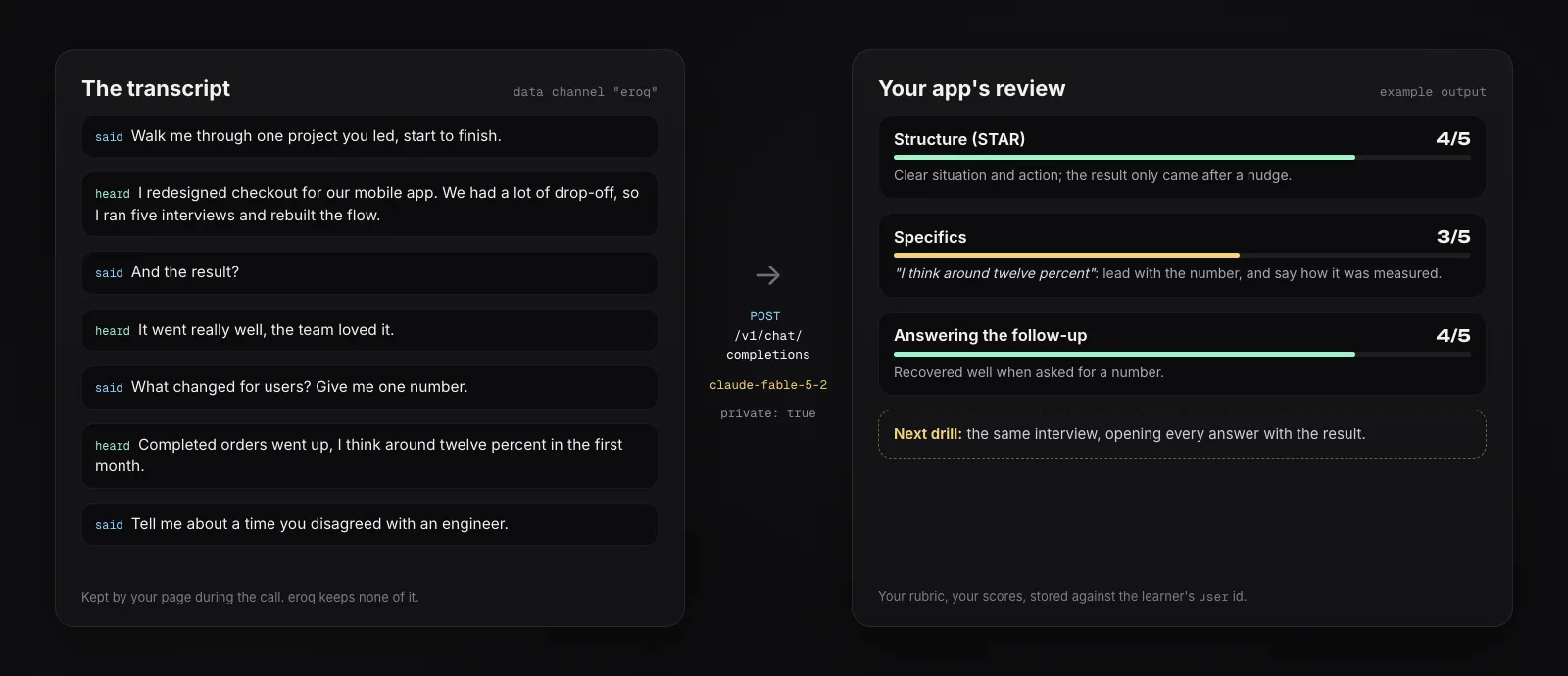
eroq does not score the interview: it hands your page the transcript, line by line, as heard (the candidate) and said (the interviewer). After the call, your server sends it to the chat API with a review prompt. This one works as a starting point:
You review a practice job interview. The transcript has two speakers: INTERVIEWER and CANDIDATE.
For each question the interviewer asked:
- score the answer's structure from 1 to 5 (situation, task, action, result),
- score its specifics from 1 to 5 (numbers, names, what the candidate did themselves),
- quote the candidate's line behind each score.
Then give three short points to work on and the one drill to do next.
Answer in JSON: {"questions": [...], "work_on": [...], "next_drill": "..."}
const res = await fetch('https://eroq.ai/v1/chat/completions', {
  method: 'POST',
  headers: { Authorization: `Bearer ${process.env.EROQ_API_KEY}`, 'Content-Type': 'application/json' },
  body: JSON.stringify({
    model: 'claude-fable-5-2',
    private: true,
    user: 'candidate_207',
    messages: [
      { role: 'system', content: REVIEW_PROMPT },
      { role: 'user', content: transcript.map(line => `${line.who}: ${line.text}`).join('\n') },
    ],
  }),
})
const review = JSON.parse((await res.json()).choices[0].message.content)
A few things to know before you ship it:
- Store the reviews by
user, so a candidate sees their scores move from one session to the next. - The transcript is what the call heard. A misheard word can slip in, and the transcription may leave out "um" and "uh", so don't build a filler-word counter on it.
- The interviewer does not see the candidate. Calls use the microphone only: there is nothing to say about eye contact or posture.
- Expect a few seconds per reply, around three in our measurements. In an interview that reads as a thoughtful interviewer. A first call can take a minute or more to pick up.
The other side: recruiters practise with an AI candidate
The same setup trains interviewers. Create a candidate, say Kai, with a persona that makes probing worth it: a strong CV, vague on results, a short last job he would rather not explain. Each call's scenario sets the drill: "You are interviewing for a team lead role. You left your last job after four months; only explain why if asked twice." The review prompt then scores the recruiter's side: open or leading questions, follow-ups, and whether they got to the result.
What it costs
A 15-minute mock interview is 1,500 credits of call, plus 20 credits for the review: $12.67 at the Scale pack's rate ($100 for 12,000 credits), $15.20 at the Starter pack's ($10 for 1,000). Credits are bought ahead, minute by minute, and a call that never connects gives its minute back.
For context, most mock interview tools are finished apps. Final Round AI has you rehearse out loud with an AI interviewer, on a Pro subscription. Jobscan has you record your answers on video or audio and gives feedback on pace, filler words and tone. Tavus offers an AI interviewer on its conversational video API for developers. eroq is the build-your-own path: your interviewer, inside your product, with nothing recorded.
Try it now in the studio
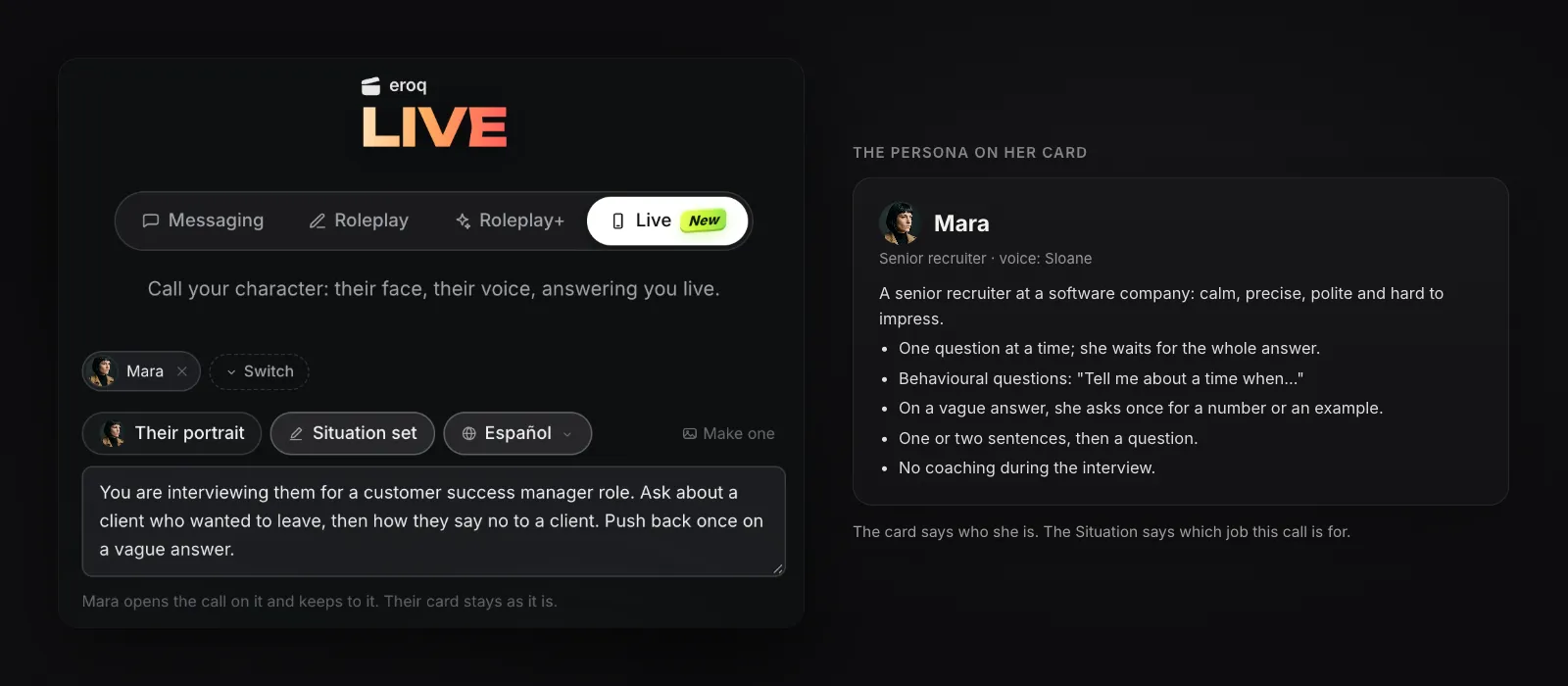
Create the recruiter in Characters, with a portrait (from photos or designed in the studio) and the persona above. Then open Live, pick her, write the role in Situation, choose the language and press Call. The studio keeps the situation and the language for her in your browser; her card does not change.
FAQ
What is an AI mock interview?
A practice interview with an AI interviewer who asks questions, listens to your answers and follows up. On eroq it happens on a video call with a character who has a face and a voice.
Can the AI interviewer ask follow-up questions?
Yes. The persona above tells her to push once on a vague answer, and each call's scenario can say where to push. She answers in a few seconds.
Does it give feedback after the interview?
Not by itself. eroq gives your app the transcript; your app writes the review, for example with the prompt above sent to the chat API.
Is the interview recorded?
No. eroq keeps no audio, video or transcript of the call. The transcript only exists where your page stores it.
Can I practise an interview in another language?
Yes. Set language on the call, for example es or pt-BR, and the interviewer keeps to it for the whole call.
How much does a mock interview cost?
100 credits per minute, so 1,500 credits for 15 minutes, plus 20 credits for a review with Claude Fable 5.2.
More: AI roleplay training by video call · AI sales roleplay · AI video call · Video call a character.