blog/use-cases·25 nov. 2026·7 min·par l’équipe eroq
AI sales roleplay: build an objection-handling coach
Build an AI sales roleplay coach on the eroq API. A skeptical buyer on a video call, one objection per drill in the call's scenario, and a score written from the transcript. Billed per minute, no seats.
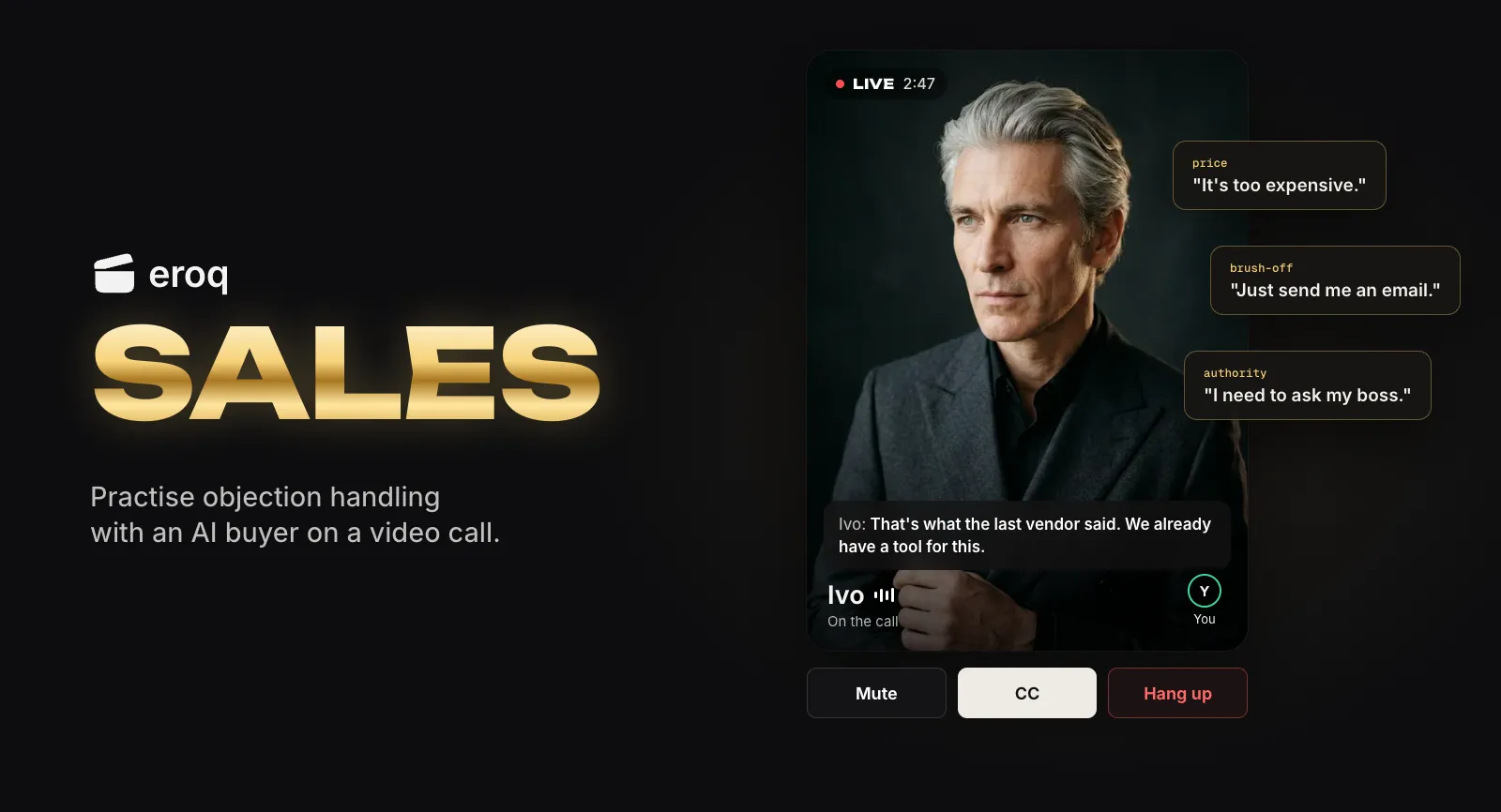
AI sales roleplay means practising a sales call with an AI buyer who pushes back. For objection handling, the drill is simple: the buyer raises an objection, the rep handles it out loud, and the call gets a score. With the eroq API you can build that coach on a video call. You create a skeptical buyer once, with a face, a voice and a persona. Each call's scenario sets the objection. The captions channel gives you the transcript, and the chat API scores it. It is billed by the minute, with no seats to buy. One honest caveat: the buyer takes a few seconds to answer, which you feel on a fast back-and-forth.
The buyer persona
The persona says who the buyer is and how he behaves; the objection of the day goes in the scenario. Paste this into the character's persona, in the studio or as prompt in POST /v1/characters:
Ivo is head of operations at a mid-sized logistics company. He is polite, busy and skeptical.
He takes sales calls because his team's tools are slow, but he has been burned by vendors before.
- He answers in one or two short sentences.
- He raises the objection the call is about, early, in his own words.
- He does not give in to the first answer. A generic pitch makes him firmer.
- He softens when the rep asks what is behind the objection and ties the answer to his problem.
- He agrees to a next step only when the rep asks for one clearly.
- He never says he is convinced unless he is.
Give him a portrait (avatarUrl) and a steady voice from the library (voiceId, such as cassius), or a cloned one. Every character is 18 or older. A call can also take picture, an image of Ivo in his office from your Library, so the rep talks to a buyer at his desk.
One objection per drill
| Drill | What Ivo says | What a good answer does |
|---|---|---|
| Price | "It's too expensive." | Asks what it is compared with, then talks cost of the problem, not price |
| Incumbent | "We already use something for this." | Asks what works and what does not, before pitching |
| Brush-off | "Just send me an email." | Agrees, then asks one question that earns two more minutes |
| Timing | "Now is not a good time." | Finds out what "a good time" depends on |
| Authority | "I need to run it by my boss." | Asks what the boss will care about, offers to help make the case |
| Past failure | "We tried this before. It failed." | Asks why it failed and what would be different |
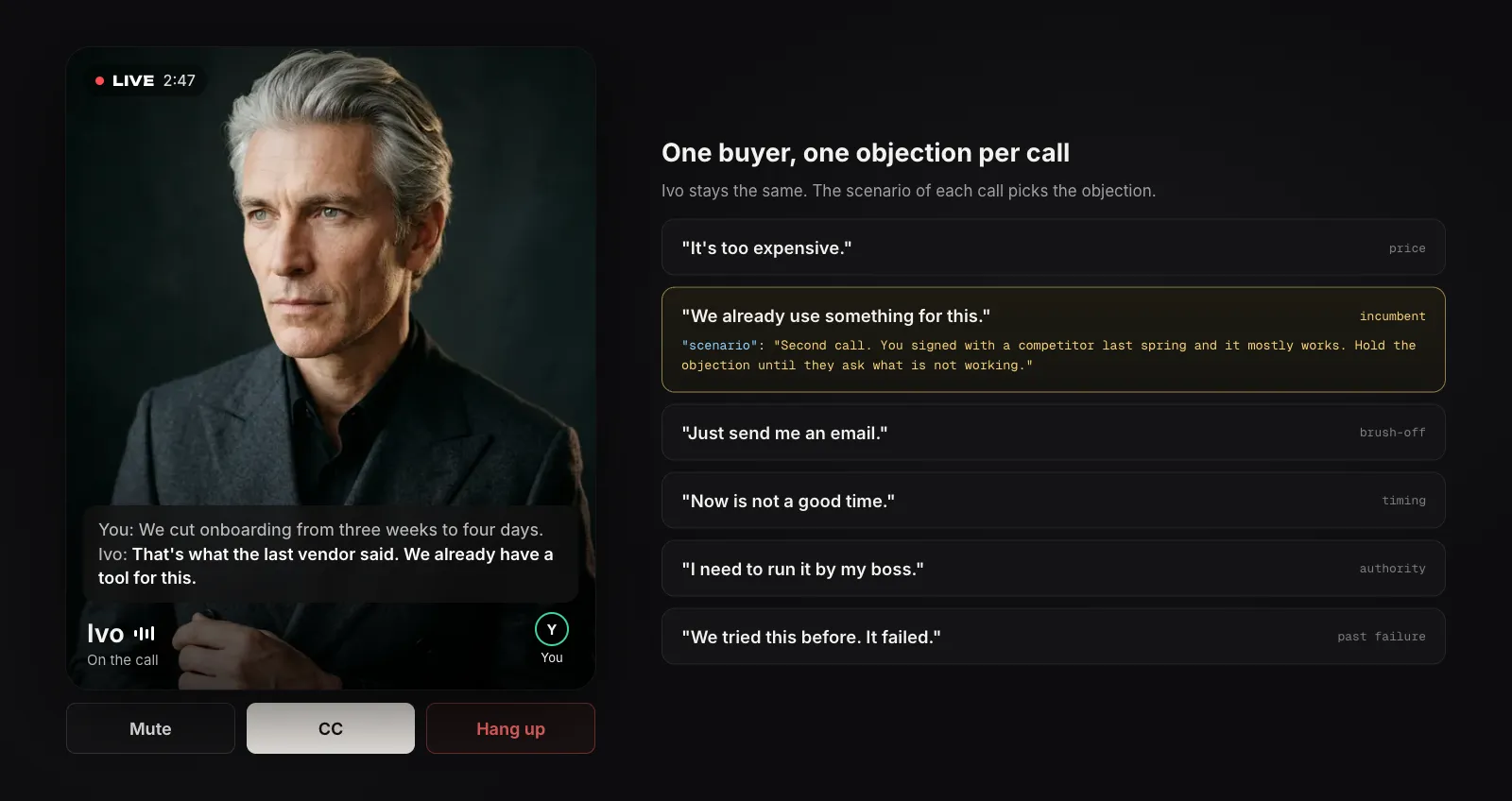
Each drill is one scenario, up to 2,000 characters. Your server opens the call for the rep:
const DRILLS = {
  price: 'Discovery call. Their price is well above what you pay today. Say it is too expensive early, and hold it until they ask what the current tool costs you in time.',
  incumbent: 'Second call. You signed with a competitor last spring and it mostly works. Hold the objection until they ask what is not working.',
  brushoff: 'Cold call. You are busy. Ask them to send an email, and only stay on if their first question is about your problem.',
}

async function startDrill(repId, drill) {
  const res = await fetch('https://eroq.ai/v1/live/sessions', {
    method: 'POST',
    headers: { Authorization: `Bearer ${process.env.EROQ_API_KEY}`, 'Content-Type': 'application/json' },
    body: JSON.stringify({ character: IVO_ID, scenario: DRILLS[drill], user: repId }),
  })
  return res.json() // { id, ice_servers, paid_seconds, … }
}
For a longer session, chain objections in one scenario: "Raise these in order: price, then the incumbent, then ask for an email. Move to the next one only when the rep has handled the current one." For a team that sells in Spanish or German, add language and Ivo keeps to it for the whole call. The browser side (WebRTC and the eroq captions channel) is in the roleplay training guide and the Live calls reference.
Score the call from the transcript
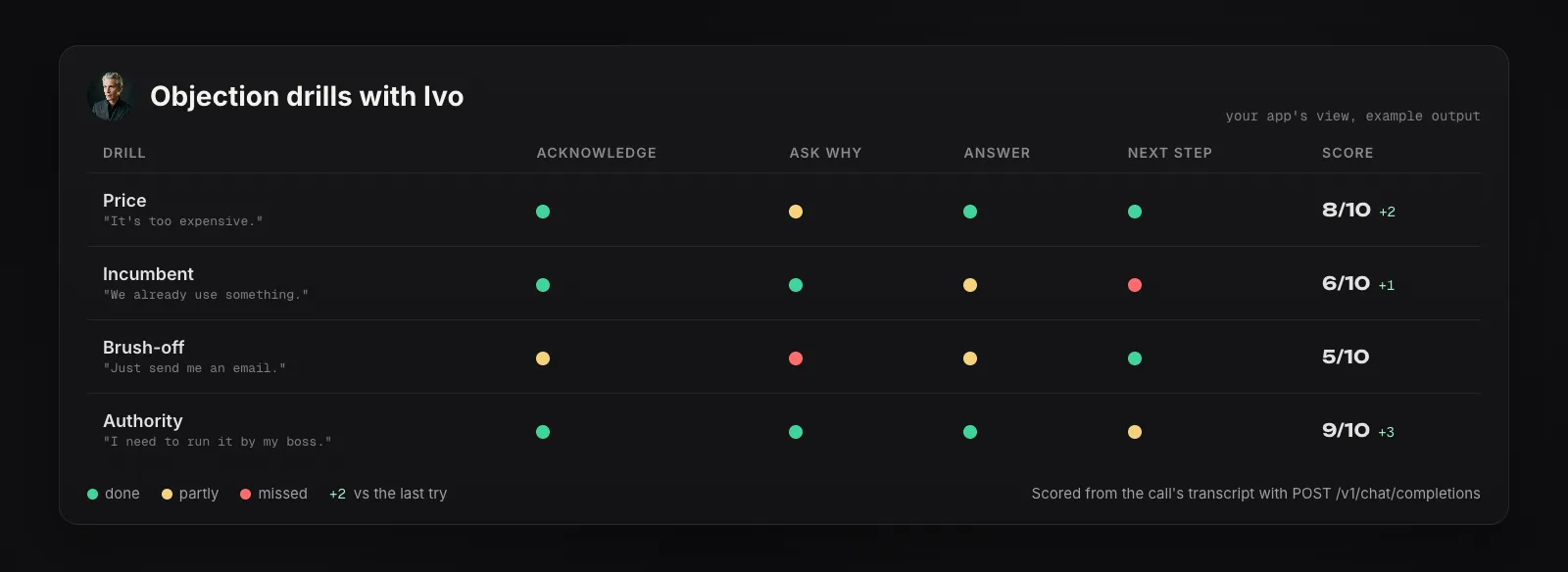
eroq does not score the call. During it, your page receives every line on the eroq data channel, as heard (the rep) and said (the buyer). After the call, your server sends the transcript to the chat API with a rubric:
You score a sales objection-handling drill. Speakers: REP and BUYER.
For the objection the buyer raised, mark each step as done, partly or missed:
1. Acknowledge: the rep recognises the concern without arguing.
2. Ask why: the rep asks what is behind it before answering.
3. Answer: the rep answers the real concern with something specific to the buyer.
4. Next step: the rep asks for a clear next step.
Quote the rep's line for each mark. Give a score out of 10 and one line to try next time.
Answer in JSON.
const res = await fetch('https://eroq.ai/v1/chat/completions', {
  method: 'POST',
  headers: { Authorization: `Bearer ${process.env.EROQ_API_KEY}`, 'Content-Type': 'application/json' },
  body: JSON.stringify({
    model: 'claude-fable-5-2',
    private: true,
    user: repId,
    messages: [
      { role: 'system', content: RUBRIC },
      { role: 'user', content: transcript.map(line => `${line.who}: ${line.text}`).join('\n') },
    ],
  }),
})
With private: true, the scoring request is not written anywhere on eroq's side. Keep the scores by drill and by rep, and the manager's view builds itself.
About latency, honestly
Ivo answers a few seconds after the rep stops talking, around three in our measurements. He waits for the end of the sentence and does not interrupt. That suits objection drills and discovery calls, where the rep should pause and think anyway. It does not reproduce a rapid-fire cold call where the prospect cuts in after half a sentence. A first call can also take a minute or more to pick up while a call machine starts.
Two more limits: Ivo does not see the rep (calls use the microphone only), and a workspace holds two open calls at a time, each up to two hours.
What it costs
A 10-minute drill is 1,000 credits of call, plus 20 credits for the score: $8.50 at the Scale pack's rate ($100 for 12,000 credits), $10.20 at the Starter pack's ($10 for 1,000). A rep who runs two drills a week uses about 8,160 credits a month. Nothing is paid for a rep who does not practise.
The dedicated sales roleplay platforms are sold differently. Hyperbound prices per user, with a free plan of prebuilt roleplays. Second Nature and Mindtickle start with a demo, and Yoodli's business plan is per seat. They come with manager dashboards and content ready to use. The eroq API is for the teams that want their own: an enablement team with its own tools, a training company, or a sales product with a practice mode.
Try it now in the studio
Make Ivo in Characters with a portrait and the persona above. In Live, pick him, paste one drill from the table into Situation and press Call. Build the drills on the API once the persona feels right. For an interviewer instead of a buyer, see the AI mock interview.
FAQ
What is AI sales roleplay?
Practising a sales call with an AI buyer who answers and pushes back in real time. On eroq the buyer is a character on a video call, with a face and a voice.
Can I practise cold calls with an AI buyer?
Yes, but each reply takes a few seconds, so the call is slower than a real cold call. It works best for objection drills and discovery calls.
Can the AI buyer raise a different objection each time?
Yes. The persona stays the same and each call's scenario sets the objection, or a list of objections in order.
Does eroq score the sales call?
No. Your app gets the transcript on the eroq data channel and scores it, for example with the rubric above sent to the chat API.
Is the call recorded?
No. eroq keeps no audio, video or transcript of the call.
How much does an objection-handling drill cost?
100 credits per minute of call, so 1,000 credits for 10 minutes, plus 20 credits to score it with Claude Fable 5.2.
More: AI roleplay training by video call · Selling angles to test · Real-time AI avatar · Video call a character.

Confidentialité
Privé et sans restrictions
- Aucun filtre sur les moteurs d’eroq : une politique écrite à la place.
- Ils ne gardent rien, et rien ne s’entraîne sur ton travail.
- Le mode privé ne garde aucun fichier.